
Urothelial and Prostate Carcinomas
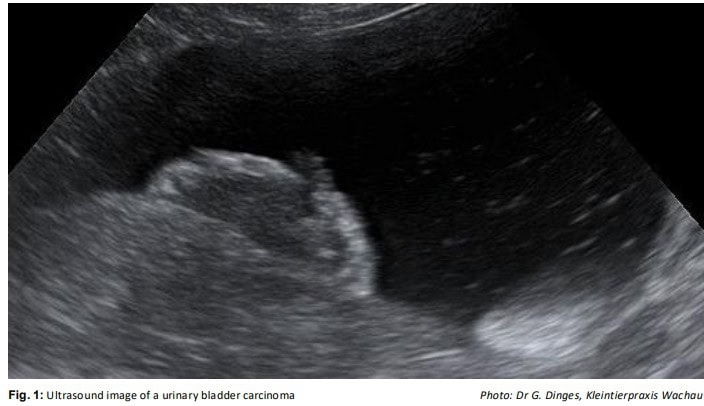
In dogs, both urothelial carcinomas (UCa) of the urinary bladder, as well as urethra and prostate carcinomas (PCa), are highly malignant neoplasms. These are often diagnosed relatively late (e.g. by ultrasound Fig. 1) and have a poor prognosis. By testing for the presence of the V595E mutation in the BRAF gene, diagnosis can be made early, and even with urine sediment. A NEW supplementary test that can be used, if no BRAF mutation has been found, and the sensitivity of the overall examination needs to be increased. At Battlab this combined test is referred to as the BRAF comp/plus test. Both tests are discussed here.
BRAF V595E mutation
The BRAF variant V595E originates from human medicine, and was first investigated in multiple canine tumours in 2015 by Mochizuki et al. In contrast to humans, where the mutation occurs primarily in malignant melanomas, ovarian tumours, thyroid and colorectal carcinomas, Mochizuki et al. (2015) found that the mutation in dogs most frequently occurs in urothelial and prostate carcinomas.
The BRAFV595E mutation is a somatic mutation in chromosome 16 that can only be detected in tumour cells. This mutation leads to tumour development via permanent activation of the MAP kinase pathway.
Indications
Testing for the presence of the BRAFV595E mutation can be helpful for the following indications:
• Screening for early detection in predisposed breeds (see below)
• Invasive sampling should be avoided by analysing spontaneous urine (sediment)
• Repeated invasive sampling can be avoided in cases with questionable histological and cytological diagnoses (poor sample quality, superimposed images of inflammation and neoplasia)
• Targeted therapy (e.g. Sorafenib; Chon et al. 2024) in selected BRAF-positive cases
Possible sample materials
• Tissue (e.g. biopsies fixed in formalin, at least 5 mm)
• Cytological smears e.g. tumour cell-rich FNA or urinary sediment (at least 2)
• Urine (1 ml urinary sediment, recommendation: spontaneous morning urine)
As the highly sensitive method of digital droplet PCR (ddPCR) is used, just 2 tumour cells with BRAFV595E mutation are sufficient to confirm the diagnosis of carcinoma.
Methodological limitations
Analyses of routine material for BRAFV595E mutation diagnostics over the past 6 years have shown that no DNA could be isolated in around 10% of the samples. This mainly occurs when non-centrifuged urine is sent in instead of sediment. As the DNA is present in the cells, a sufficiently high proportion of epithelial cells must be present in the sample to isolate sufficient DNA. In principle, cell-free DNA can also be detected, but this is not an option that should be relied upon when selecting the material.
In rare cases, inhibitors can also be the reason why no DNA can be isolated despite a sufficient number of cells.
Bacterial overgrowth in the urine usually does not pose a problem in detecting the BRAFV595E mutation.
Specificity and sensitivity
The specificity of the BRAFV595E mutation diagnostics is 100%, as the BRAF mutation could not be detected in any of the dogs with cystitis, bladder polyps or similar.
This also applies to prostate carcinomas, as the BRAFV595E mutation was not found in benign prostatic hyperplasia, squamous metaplasia or atrophy of the prostate (Mochizuki et al. 2015a). Depending on the study and dog breed, the sensitivity of detecting the BRAF mutation in UCa is 71% and 61% for PCa. Even early stages (dysplasia) of UCa with a BRAF mutation were detectable in one case report (Chambers et al. 2024).
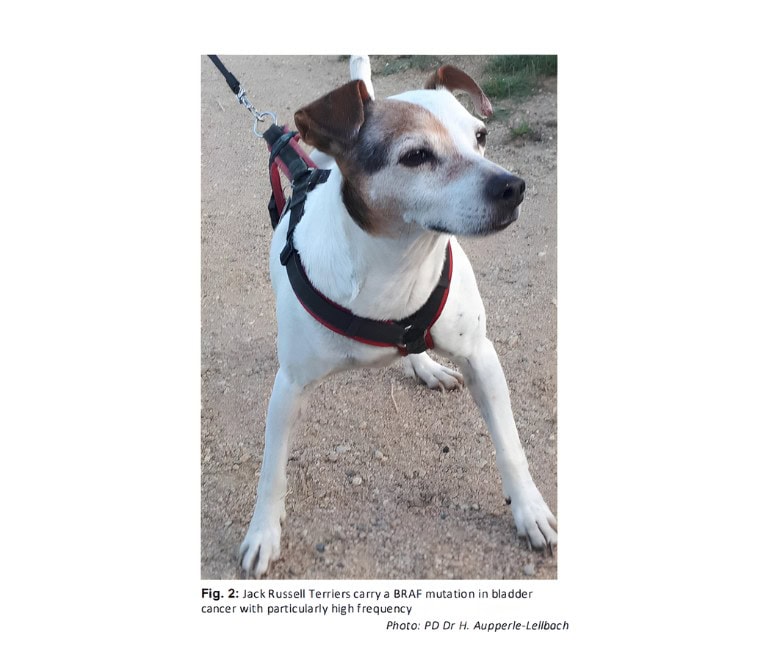
Current analyses of routine material from Battlab over the past 6 years have shown that the proportion of BRAF-positive samples in the submitted material is exceptionally high in certain terrier breeds (Fig. 2), Shetland Sheepdogs and Beagles. However, this tells nothing about the sensitivity, as no information is available on whether the negative cases actually had a tumour. However, these observations indicate that mutation is regularly found in samples from these breeds.
Interpretation of test result
Only a positive result is conclusive for a carcinoma.
If no BRAF mutation is detectable in the sample, the following scenarios are possible:
• There is no UCa / PCa (e.g. polyp, benign hyperplasia).
• No mutated cells are in the sample, but a carcinoma is present. (questionable representativeness of the sample, e.g. cell-poor cytology/urine).
• The BRAFV595E mutation does not cause the carcinoma.
• The new CNA test may be helpful (see below).
NEW: BRAF Comp.
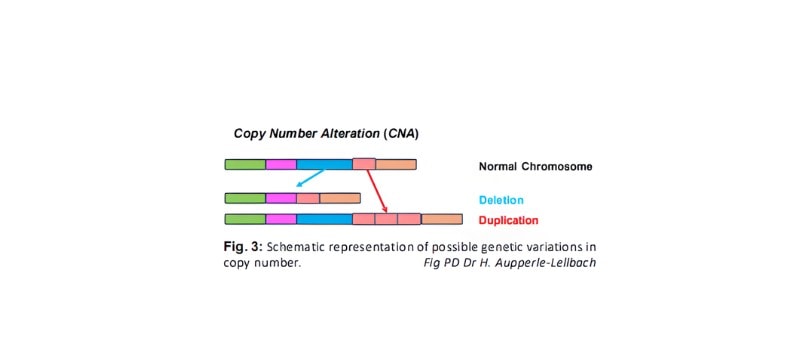
Battlab has added a further molecular genetic test (CNA) to diagnose bladder carcinomas and create a complete BRAF comp. panel. The CNA analysis is based on detecting an altered number of specific gene segments.
In principle, structural gene alterations can lead to a loss or multiplication of gene segments (copy number alteration, CNA). Fig. 3
Copy Number Alteration (CNA) in Canine Urothelial Carcinoma
Duplications on chromosomes 13 and 36 or deletions on chromosome 19 were found in >75% of cases of canine urothelial carcinoma, with >93% having two or more of these CN alterations(Shapiro et al. 2015). These changes were absent in urine samples from dogs with urinary tract infections, cystitis or benign bladder polyps (Mochizuki et al. 2016). These gene alterations are NOT detectable in canine prostate carcinomas (see Fig. 4).
By quantifying these copy numbers, it is now possible to identify urothelial carcinomas that do not have a BRAFV595E mutation. The combined test is offered as BRAF comp. by Battlab and corresponds to the CADET® BRAF-PLUS test in the
US.
However, the altered copy number is unrelated to the BRAF mutation. It is nevertheless an independent molecular genetic phenomenon that can only be detected in the tumour cells of canine urothelial carcinomas. The molecular consequences at the protein level or within signalling cascades have not yet been investigated. To what extent a therapeutic or prognostic statement is possible for dogs with
these CNAs in urinary bladder carcinoma remains to be explored.
Methodological limitations
In principle, the material already submitted for BRAF mutation analysis (see above) can also be used for CNA analysis. BUT: Better DNA quality is required, as not only the BRAFV595E point mutation is analysed, but also more significant gene segments, therefore a good quality sample is required. There is, therefore, a risk that the CNA analysis will not provide a usable result, if the urine is low in cells and/or has bacterial overgrowth. It is therefore recommended that the BRAFV595E mutation analysis be performed first, and that a subsequent CNA analysis is only considered, if the result is negative (see Fig. 4).
And as the result of the molecular genetic tests is only known once the analysis has been fully completed, the test is being charged, even if no usable result could be obtained, despite repeated testing.

Conclusion
Testing for the BRAF mutation is a highly specific method (100%) for detecting canine urothelial and prostate carcinoma.
The newly established test for variations in the copy number of specific gene segments (CNA) increases the sensitivity of the molecular genetic diagnosis of urothelial carcinomas.
PD Dr Heike Aupperle-Lellbach, Alexandra Kehl
Our Services:
• BRAF mutation (V595E)
• BRAF comp/plus (V595E + 2 CNA)
• Subsequent request for CNA in case of a negative BRAF