


Persistent or intermittent nasal discharge (ND) in dogs and cats is a common clinical sign that may indicate a serious underlying condition. The character of the nasal discharge (serous, purulent, or bloody) or its location (unilateral or bilateral) provides only limited guidance for narrowing down the list of differential diagnoses. A thorough, stepwise diagnostic work-up is usually required.
Causes
The most common causes of chronic nasal discharge (ND) in small animals include, in addition to possible infections, space-occupying lesions in the nasal cavity, foreign bodies or debris, oronasal defects, dental pathology, and idiopathic rhinitis (IR). Systemic diseases can also lead to ND, such as endocrinopathies, systemic infections (e.g., leishmaniasis, ehrlichiosis, rickettsiosis, bartonellosis), and anaemias/haematopathies/coagulopathies. Table 1 provides an overview of the most frequent conditions that may be associated with ND.
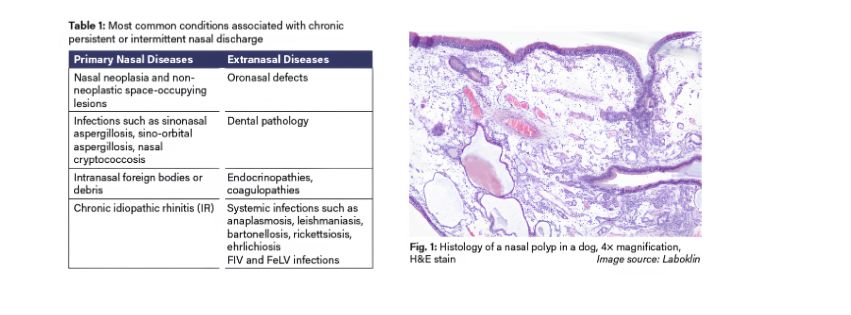
The most common primary nasal diseases are described in more detail below.
Space-Occupying Lesions in the Nasal Cavity
Both malignant and non-neoplastic space- occupying lesions can affect the nasal cavity. Regardless of their nature, these lesions may be associated with unilateral or bilateral nasal discharge (ND) of varying character (serous to bloody), stridor, sneezing, and, in cases of larger masses, even skull deformities. All are accompanied by secondary chronic inflammation.
Non-Neoplastic Nasal Masses
Nasal polyps (NP) and hamartomas appear on radiographs as soft-tissue-dense masses, and macroscopic distinction between a non-neoplastic lesion and a benign or malignant neoplasm is not reliably possible. In cats, nasopharyngeal polyps arising from the pharyngeal region, the auditory tube, or the tympanic bulla have also been described as a separate entity. The exact pathogenesis in both cases remains unclear. Nasal and nasopharyngeal polyps are exophytic proliferations of markedly oedematous and sometimes myxoid fibrovascular stroma, covered by well-differentiated respiratory epithelium (Fig. 1). Individual glands and lymphatic vessels in the stroma are often dilated. They are associated with turbinate destruction, and recurrence is possible.
Nasal Neoplasia
The majority of nasal neoplasms are malignant. Regardless of their histogenesis, they tend to grow relatively slowly, causing significant destruction of anatomical structures and secondary inflammation. Metastases (to regional lymph nodes and the lungs) usually occur late and are often absent at the time of diagnosis. In both dogs and cats, epithelial tumours appear to be more common than non-epithelial tumours, most frequently adenocarcinomas arising from the respiratory, olfactory, or glandular epithelium, as well as transitional cell carcinomas or squamous cell carcinomas.
For non-epithelial tumours, prevalence differs between dogs and cats. In cats, nasal lymphomas, followed by fibrosarcomas, are the most common tumours after carcinomas, whereas in dogs, chondrosarcomas are the most frequent non- epithelial tumours.
Infectious Causes of Chronic Nasal Discharge
Bacterial Rhinitis
Chronic bacterial rhinitis in dogs and cats usually occurs secondarily to other nasal diseases. According to current literature, primary bacterial rhinitis is very rare.In dogs, Bordetella bronchiseptica has been discussed as a possible primary pathogen. In most cases, chronic rhinitis develops secondarily, with bacteria acting as opportunistic pathogens on nasal mucosa that has already been damaged. The most frequent underlying conditions include idiopathic rhinitis (IR), nasal neoplasms, and nasal mycoses. Secondary bacterial infections of the nasal mucosa can also occur in the context of oronasal defects, intranasal foreign bodies, and dental pathology.In cats, damage to the respiratory epithelium following acute infection with feline herpesvirus 1 or calicivirus can lead to chronically recurrent bacterial rhinitis.Bacterial culture with identification of the causative agent and antimicrobial susceptibility testing is recommended in chronic and chronically recurrent cases.
Nasal Mycoses
Fungal rhinitis in dogs and cats is rare but well- defined, with Aspergillus infections being the most common. Other moulds and yeasts may also be involved.
Unlike other mycoses, in which immunosuppressive mechanisms predispose to fungal infections, nasal mycoses occur in immunocompetent animals. Canine and feline sinonasal aspergillosis (SNA) is the most common form of fungal rhinitis, with cats being affected less frequently than dogs. It is associated with severe destruction of the conchae and turbinates. Endoscopically, yellow fungal plaques and granulomas can be observed (Fig. 2). In dogs, the frontal sinuses may also be involved. Etiologically, most cases are caused by Aspergillus fumigatus infection.
In cats, an invasive granulomatous form called sino-orbital aspergillosis occurs when the infection spreads from the nasal and sinus cavities into the orbit and surrounding tissues. Clinically, in addition to chronic rhinitis, exophthalmos, orbital pain, and neurological or facial abnormalities may occur.
Another entity caused by yeast infection is nasal or nasopharyngeal cryptococcosis, which occurs in cats and, less commonly, in dogs. In cats, nasal to nasopharyngeal masses without bony destruction are particularly notable, whereas in dogs, turbinate lysis may be observed.
Histology and microbial culture are suitable for distinguishing these conditions and identifying the causative agent. Serological testing is useful for monitoring therapy and disease progression.

Chronic Rhinitis of Unknown Cause / Idiopathic Rhinitis (IR)
In addition to nasal neoplasms and sinonasal aspergillosis (SNA), idiopathic rhinitis (IR) is the most common diagnosis in cases of chronic nasal discharge (ND), particularly in dogs. It is a diagnosis of exclusion that requires ruling out all other
possible nasal and systemic causes. IR shows no breed or sex predisposition, although it appears to affect larger, predominantly mesocephalic to normocephalic dog breeds more frequently.
The pathogenesis of IR remains unclear. Various pathogenic mechanisms or aetiological triggers, such as primary and secondary infectious insults, have been discussed. It is suggested that IR may have a multifactorial aetiology and can vary from patient to patient. Investigations have also considered immune-mediated mechanisms and hypersensitivity reactions, showing a partial TH2 immune response, which could indicate a possible allergic basis. However, definitive evidence for allergic rhinitis in dogs, as known in humans, is currently lacking. Literature reports that dogs with IR, even when eosinophils are present in the cytology, typically show only weak and inconsistent responses to antihistamines and glucocorticoids.
Histopathological findings in IR include an inflammatory cell infiltrate dominated by lymphocytes and plasma cells, often accompanied by neutrophils and, less commonly, eosinophils. In the English-language literature, due to the predominance of lymphocytes and plasma cells, the terms lymphoplasmacytic rhinitis (LPR) or idiopathic lymphoplasmacytic rhinitis are used synonymously. Erosions, ulcerations, bleeding, and turbinate atrophy are also observed in association with IR.
Histopathological changes in IR may occur unilaterally or bilaterally and in varying degrees. However, the inflammatory cell infiltrates are non-specific, and no conclusions regarding aetiology can be drawn. Similar inflammatory and tissue changes can also occur secondary to oronasal defects or dental-related rhinitis.
Diagnosis of Chronic Nasal Diseases
The evaluation of chronic nasal diseases is a stepwise process. This includes a clinical examination, imaging, preferably using CT or MRI, rhinoscopy with targeted biopsy, followed by histopathological and/or cytological analysis, and, if indicated, further microbial and mycological culture, serological testing for antigens or antibodies, and/or pathogen detection via PCR.
The following sections provide a detailed overview of the diagnostic steps.
Clinical Examination
External inspection may reveal depigmentation of the nasal planum, inflammation of the surrounding skin, crusts, hyperkeratosis, as well as asymmetry or swelling. Other respiratory signs, such as stridor, sneezing or reverse sneezing, may accompany chronic ND. An oral examination should also be performed to evaluate for dental pathology and inflammation. However, even with a normal oral examination, dental problems, for example oronasal fistulae, cannot be ruled out as a cause at this stage.
Imaging
Imaging is essential in the diagnosis of chronic nasal diseases, particularly with CT or MRI. Conventional radiography is limited in its usefulness due to superimposition of bony structures, making evaluation of the skull, turbinates and conchae
difficult. Oronasal defects, dental pathology and space-occupying lesions cannot be reliably assessed with plain radiographs. CT or MRI before endoscopy is recommended because endoscopic examination cannot visualise all areas. Furthermore, secondary lesions may be caused by endoscopy itself, potentially complicating the interpretation of imaging studies conducted after the procedure.
Rhinoscopy
Endoscopic examination should be performed both rostrally through the nasal passages and pharyngeally, in a retrograde approach through the choanae. Foreign bodies, debris, or fungal plaques can be visualised and removed. This also allows targeted sampling of the nasal mucosa under direct visual control. Blind biopsies carry the risk of missing relevant lesions and sampling areas that may not be representative.
Histopathological and Cytological Examination
For histopathology, it is generally recommended to collect multiple samples from both nasal cavities, even if only unilateral, focal changes are detected. In particular, for space-occupying lesions, a reliable diagnosis is only possible through histopathological examination of appropriate and representative tissue biopsies. Three to four core biopsies of the primary lesion are considered suitable. Insufficient or excessively small tissue samples increase the risk of missing the lesion, which may result in false-negative findings.
In some cases, cytological preparations are suitable for an initial assessment. For nasal mycoses and neoplasms, cytological smears from representative areas may be sufficient to establish a diagnosis (Fig. 3). However, it should be noted that negative results do not exclude these differential diagnoses. Histological examination is essential for determining tumour type.
Conclusion
Chronic nasal discharge (ND) is a clinically significant symptom and encompasses a wide range of differential diagnoses. A thorough, stepwise diagnostic approach is therefore required.
Dr. med. vet. Sandra Franke
Our services on this topic:
– Histology
– Cytology
– Bacteriology and mycology
FURTHER LITERATURE

Pauly A. Immunhistochemische Untersuchungen zur Expression von Tumormarkern und Wachstumsfaktorrezeptoren bei Hunden mit malignen Nasentumoren [Dissertation]. Leipzig: Universität Leipzig; 2021.
Franke S. Immunhistochemische Untersuchung zur Phänotypisierung und zur Quantifizierung von Entzündungszellen in Nasenschleimhautbioptaten von Hunden mit idiopathischer Rhinitis und anderen chronischen Rhinitiden [Dissertation]. Hannover: Tierärztliche Hochschule Hannover; 2024.
Rösch S, Bomhard WV, Heilmann RM, Oechtering GU. Nasenausfluss beim Hund – Wie sinnvoll sind bakteriologische und histopathologische Untersuchungen? Tierarztl Prax Ausg K Kleintiere Heimtiere. 2019;47(2):84–96.